Brewing While America Sleeps: The Strange, Beautiful Hours of the Small-Batch Brewer
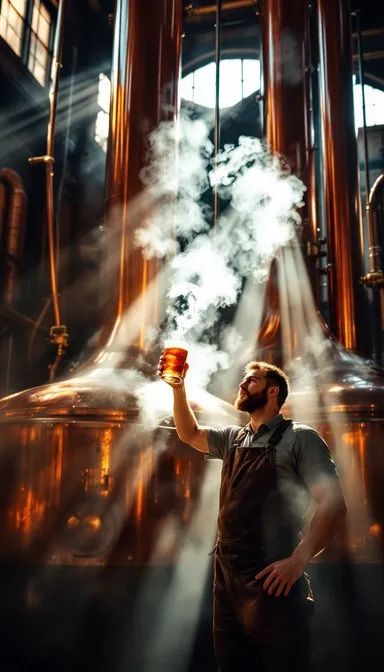
Photo: brewer working night shift in craft brewery with steam and low lighting, via images.stockcake.com
There's a particular kind of silence at 2:47 a.m. in a brewery. The compressors hum. The kettle steams. And somewhere in the dark, a brewer in rubber boots is checking a thermometer by headlamp, waiting for a mash to hit 152 degrees exactly.
If you've ever wondered why your favorite small-batch saison tastes like nobody else could make it, part of the answer might be simple: it was brewed while you were asleep.
Why the Wee Hours Matter
Big production breweries run around the clock by necessity — their schedules are dictated by tank capacity and distribution contracts. But small-batch brewers often choose the night shift deliberately, and the reasons are more romantic than you'd think.
Cooler ambient temperatures matter. A lot. When you're brewing something delicate — a mixed-fermentation farmhouse ale, a hop-forward pilsner, anything where yeast character is the star — temperature swings are the enemy. Overnight brewing in an un-air-conditioned brewhouse means more stable conditions and less stress on fermentation from the very first minute.
There's also the matter of attention. A brewer at 3 a.m. isn't splitting focus between a delivery driver, a taproom manager, and a phone buzzing with inventory questions. The brew is the only thing happening. For beers where a five-minute difference in whirlpool timing changes the aroma profile, that kind of single-minded focus isn't a luxury. It's the whole game.
A Night in the Life: Portland, Maine
Take someone like Dana Whitfield (we've changed her name, but her schedule is real), who brews for a two-barrel operation in Portland, Maine. Her day starts at 1:30 a.m. with a cup of coffee and a walk-through of the brewhouse — checking yeast health, confirming water chemistry, reading the room. Literally. She logs the temperature and humidity before touching a single valve.
By 3 a.m., the mash is in. By 5, the boil. By 7, when the first early-rising tourists wander past the glass garage door hoping for a tasting, she's pitching yeast and cleaning kettle #2. Her beer goes into the world tasting like patience and precision — and nobody drinking it will ever know it was born in the dark.
"People think brewing is a party," she told us. "It's a night shift with better smells."
The Economics of Exhaustion
Here's the part that separates small operations from corporate ones: when you brew twelve barrels at a time, you can't afford a bad batch. A single infected tank at a macro brewery is a rounding error. At a nano-brewery, it might be a month of revenue.
That math changes behavior. Small brewers baby their fermentations. They check gravity readings at hours that would make a labor lawyer wince. They brew overnight not because it's cheaper — often it's not — but because the batch deserves it, and because they can. Try getting a 40,000-barrel production run scheduled around the phases of the moon. You can't. A two-barrel system? You can brew whenever the beer needs you to.
There's a stubbornness to it, too. Ask around at small breweries across the country and you'll hear the same story in different accents: brewers who've pulled all-nighters waiting on a stuck fermentation, who've slept on a cot next to the glycol chiller, who've driven back to the brewery at midnight because the fridge controller lost power during a heat wave in Texas.
The Flavor Payoff
Does any of this actually show up in the glass? Ask anyone who's compared a mass-produced lager to a carefully made small-batch one and the answer is obvious.
Freshness, consistency, and complexity — the three things craft beer drinkers chase — are all downstream of process control. And process control, at the small scale, is ultimately about human attention. A brewer who's standing over the kettle at 4 a.m. catches the moment the boil gets lazy. A brewer who's asleep doesn't.
There's also a quieter benefit: the night shift builds a different relationship with the beer. Brewers who work the dark hours talk about their batches almost like collaborators. They learn the sounds a healthy fermentation makes. They notice when something smells one degree off. That intimacy is impossible to fake, and it's part of why small-batch beer keeps punching above its weight.
Next Time You Raise a Glass
So the next time you're holding a pour of something small-batch and remarkable, spare a thought for the person who made it — probably bleary-eyed, probably caffeinated, probably watching a bubble count in a airlock while you were dreaming.
The best beer in America isn't brewed on a schedule. It's brewed when the beer says so. And sometimes that's 3 a.m.