Turn It Down: How Quiet Taprooms Are Changing the Way We Actually Taste Beer
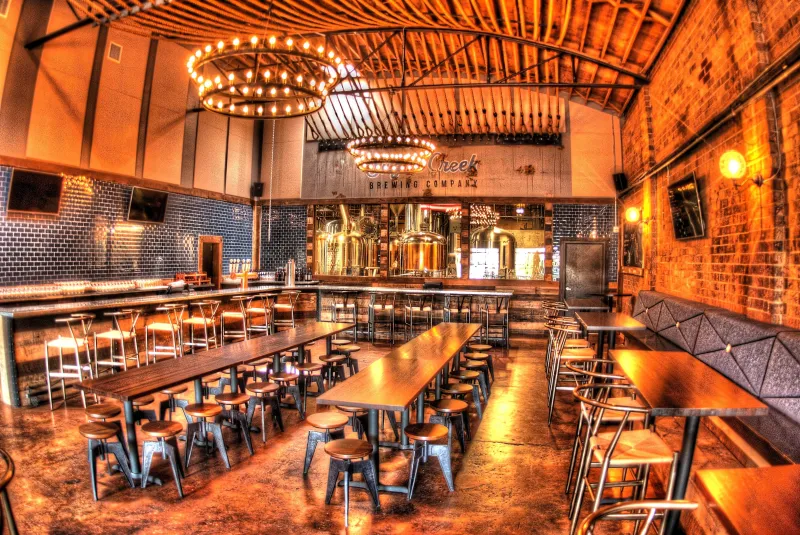
Photo: quiet cozy brewery taproom with wood paneling and soft lighting, via i.pinimg.com
Walk into most craft taprooms on a Friday night and you know the drill. Music thumping at a volume that makes conversation a full-contact sport. Stools scraping concrete floors. A crowd competing with itself to be heard. It's a good time — nobody's arguing that. But here's the thing nobody's talking about: all that noise is quietly wrecking your ability to taste the beer in your hand.
A handful of forward-thinking breweries across the country are starting to take that seriously. They're building spaces that feel less like a sports bar and more like stepping into a clearing in the woods — intentionally calm, acoustically considered, and designed around the idea that great beer deserves your full attention.
The Science of Sound and Flavor
This isn't just vibes. There's genuine research behind the relationship between ambient noise and taste perception. Studies out of Oxford's Crossmodal Research Laboratory — led by experimental psychologist Charles Spence — have demonstrated that loud, chaotic environments suppress our ability to detect sweetness and subtle flavor nuance, while quieter settings tend to heighten sensitivity to bitterness and complexity. For a craft brewer who spent six months coaxing forest-floor earthiness out of a wild ale, that's a pretty brutal trade-off.
High decibel environments also trigger mild stress responses that divert cognitive resources away from sensory processing. In plain terms: when your brain is working overtime just to parse what the person next to you is saying, it's got less bandwidth left over to notice that whisper of dried cherry on the back end of your barrel-aged stout.
Some breweries are now treating acoustics the way they treat water chemistry — as an ingredient worth controlling.
What a Quiet Taproom Actually Looks Like
The design principles aren't complicated, but they require intentionality. Sound-absorbing materials — reclaimed wood panels, thick textiles, moss walls, exposed timber beams — do double duty. They nod to the natural, forest-rooted aesthetic that a lot of craft breweries already lean into, and they kill the reverb that turns a room full of people into a wall of noise.
Lighting matters too. Dimmer, warmer light signals to guests that this is a place to slow down. Seating arrangements that encourage smaller, more intimate groupings rather than long communal rows help keep volume naturally in check. Some taprooms are going further — designated quiet hours, no-screen zones, or separate tasting rooms with explicit low-noise expectations.
Think of it less as a library and more like sitting around a fire in the woods. Conversation still happens. Laughter still happens. But there's a different register to it.
Breweries Leading the Shift
While this is still an emerging trend, you can see it taking shape in pockets across the country. Taprooms in the Pacific Northwest — where the forest-meets-craft-beer culture runs deep — have been early adopters, incorporating natural materials and intentional quiet hours. A few New England farmhouse breweries have leaned into the concept as an extension of their terroir-forward brand identity, framing the quiet tasting experience as part of what makes their product worth savoring.
Some spots have introduced structured tasting flights with guided sensory cards — prompts that encourage drinkers to slow down and actually articulate what they're tasting. It sounds fussy until you try it, and then it feels like finally reading the footnotes on a book you've been misreading for years.
The Pushback (And Why It's Missing the Point)
Not everyone's on board. Critics argue that stripping the energy out of a taproom kills the social glue that makes craft beer culture what it is. And fair enough — nobody wants to drink a hazy IPA in a sensory deprivation chamber.
But the quiet taproom movement isn't really about silence. It's about intentionality. It's about creating space — literal and figurative — for the beer to speak. The breweries embracing this approach aren't trying to turn their taprooms into meditation halls. They're recognizing that the experience of tasting a genuinely complex, small-batch beer is diminished when it has to compete with a soundtrack cranked to 85 decibels.
At Deep Dark Wood, that idea resonates pretty deeply. We spend a lot of time thinking about what goes into the glass. It makes sense to spend some time thinking about the environment around the glass too.
What This Means for the Craft Beer Experience
If you've ever stood in a loud taproom, taken a sip of something genuinely special, and thought — wait, what was that? — only to lose the thread in the noise, you already understand the problem. The quiet taproom movement is an answer to that moment.
It's also a differentiator. In a crowded craft beer market where breweries are constantly looking for ways to make their brand mean something beyond what's in the can, the experience of the space itself becomes part of the value proposition. A taproom that helps you taste better isn't just a nice environment. It's a statement about how seriously you take your craft.
Turn it down. Taste more. It really is that simple.