What's In Your Water? The Hidden Ingredient That Makes or Breaks a Craft Beer
Ask most beer drinkers what goes into their favorite IPA or stout, and you'll get a pretty standard answer: hops, malt, yeast. Maybe someone throws in "adjuncts" if they've been hanging around craft beer circles long enough. But there's a fourth ingredient that doesn't get nearly the attention it deserves — one that makes up roughly 90 to 95 percent of every single pint you've ever enjoyed.
Water.
Not glamorous, sure. But spend five minutes talking to a serious brewer and you'll quickly realize that water chemistry isn't just a technical footnote — it's the foundation everything else is built on. Here at Deep Dark Wood Brewing, we've spent a lot of time thinking about where our water comes from, what's in it, and how those invisible mineral signatures shape the bold, forest-deep flavors we chase in every batch.
Why Water Source Actually Matters
Before municipal treatment systems and reverse osmosis filtration became standard tools in the brewer's toolkit, geography was destiny. The reason certain beer styles became associated with specific cities wasn't just cultural — it was geological.
Burton-on-Trent in England became synonymous with pale ales because its water is loaded with calcium sulfate, a mineral that sharpens hop bitterness and gives the beer a dry, clean finish. Pilsen in the Czech Republic, on the other hand, sits on some of the softest water in Europe — low in almost every mineral — which is exactly why the original Pilsner lager came out so delicate and smooth. Dublin's hard, carbonate-heavy water helped shape the dry, roasty character of Irish stouts.
The water didn't follow the beer. The beer followed the water.
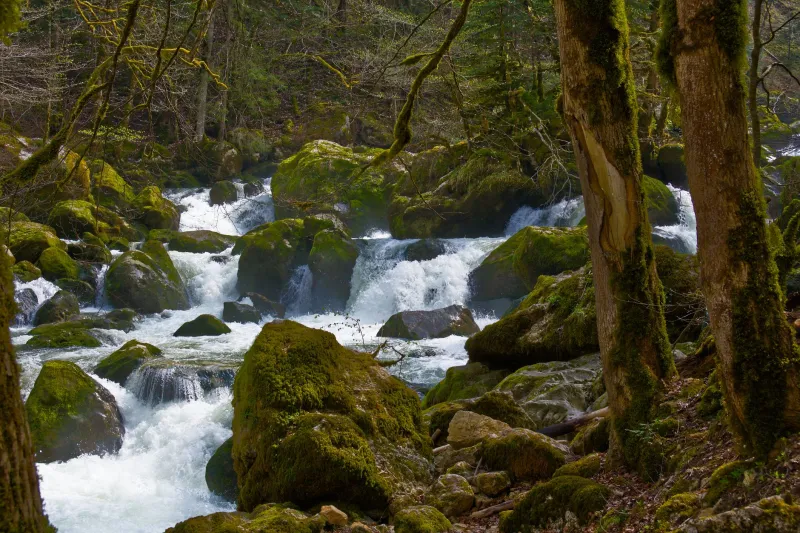
Forest-fed springs and mountain groundwater sources carry their own distinct mineral fingerprints, shaped by the geology they travel through on their way to the surface. Water percolating through granite-heavy terrain picks up very different compounds than water moving through limestone or sandstone. Those differences — measured in parts per million — translate directly into what your palate experiences.
The Mineral Players and What They Do
When brewers talk about water chemistry, they're mostly focused on a handful of key ions. Here's a quick breakdown of the main characters:
Calcium is the workhorse. It helps enzymes function properly during the mash, promotes yeast health during fermentation, and contributes to overall beer clarity. Most brewers target somewhere between 50 and 150 parts per million.
Sulfate (usually added as calcium sulfate, or gypsum) emphasizes hop dryness and bitterness. Bump it up and your IPA gets a sharper, more assertive bite. Dial it back and things soften considerably.
Chloride does roughly the opposite — it rounds out malt character, adds a sense of fullness and sweetness, and makes the beer feel more lush on the palate. A stout or a malt-forward amber ale often benefits from a higher chloride-to-sulfate ratio.
Bicarbonate is a major driver of water hardness and affects pH in the mash. High bicarbonate levels can push the mash pH too high, which dulls enzyme activity and can lead to harsh, astringent flavors — particularly in lighter beers. Dark malts, being naturally acidic, can actually balance this out, which is part of why dark beers historically thrived in hard-water regions.
Magnesium and sodium round out the picture in smaller roles, contributing to yeast nutrition and overall flavor perception, respectively.
pH: The Number That Ties It All Together
If mineral content is the ensemble cast, pH is the director. Mash pH — ideally landing somewhere between 5.2 and 5.4 for most beer styles — governs how efficiently enzymes convert starches to fermentable sugars. Stray too far in either direction and you're looking at a beer that either tastes thin and underfermented or harsh and astringent.
Brewers adjusting water for a specific recipe aren't just guessing. They're using the known mineral content of their source water as a baseline, then adding brewing salts or acids to dial in exactly where they need to be. It's part art, part chemistry lab — and honestly, it's one of the more satisfying puzzles in the whole brewing process.
"Water is the canvas," one brewer we talked to put it simply. "Everything else you do is painting on top of it. If the canvas is wrong, it doesn't matter how good your brushwork is."
Forest Springs and What Makes Them Special
There's a reason "spring water" carries so much romantic weight in the craft beverage world. Springs fed by forest watersheds often benefit from natural filtration through layers of organic material and mineral-rich rock. The result is water that's clean, relatively consistent in mineral content, and — in many cases — already pretty well-suited to brewing without a ton of adjustment.
Forest environments also tend to be more protected from agricultural runoff and industrial contamination, which matters for flavor purity even if it's not always top of mind. When you're brewing small-batch beer where every variable counts, starting with genuinely clean, characterful source water is a meaningful advantage.
Of course, even great spring water usually needs some fine-tuning depending on the style. A brewer working with a naturally soft forest spring source might add gypsum to build up sulfate levels for a West Coast IPA. The same source water, treated differently — maybe with a touch more calcium chloride — could be the perfect foundation for a creamy, malt-forward porter.
Building a House Profile
Many craft breweries develop what's sometimes called a "house water profile" — a baseline mineral target they hit for most of their beers, with adjustments made style by style from there. It's part of what gives a brewery its signature character. Two breweries using the same malt and hops can end up with noticeably different beers if their water treatment philosophies diverge.
At Deep Dark Wood, the idea of a house profile resonates deeply with our identity. We're not chasing trend-of-the-month flavors or brewing to some generic template. We're building something that reflects where we're rooted — the deep woods, the mineral-laced groundwater, the quiet specificity of a particular place. Water chemistry is one of the most direct ways we can express that in the glass.
The Takeaway for Beer Drinkers
You don't need to become a water chemistry nerd to appreciate great craft beer — though fair warning, once you start going down that rabbit hole, it's hard to stop. What's worth taking away is a simple appreciation for the invisible complexity behind every well-made pint.
Next time you crack open a beautifully bitter IPA or sink into a velvety dark ale, there's a whole geological story underneath the flavor. The water that built that beer might have spent decades — maybe centuries — slowly working its way through layers of rock and forest floor before it ever hit a brewing kettle.
That's not just chemistry. That's craft.
And at Deep Dark Wood Brewing, it's exactly the kind of detail we think is worth obsessing over.