Reading the Head: What Beer Foam Says Before the First Sip
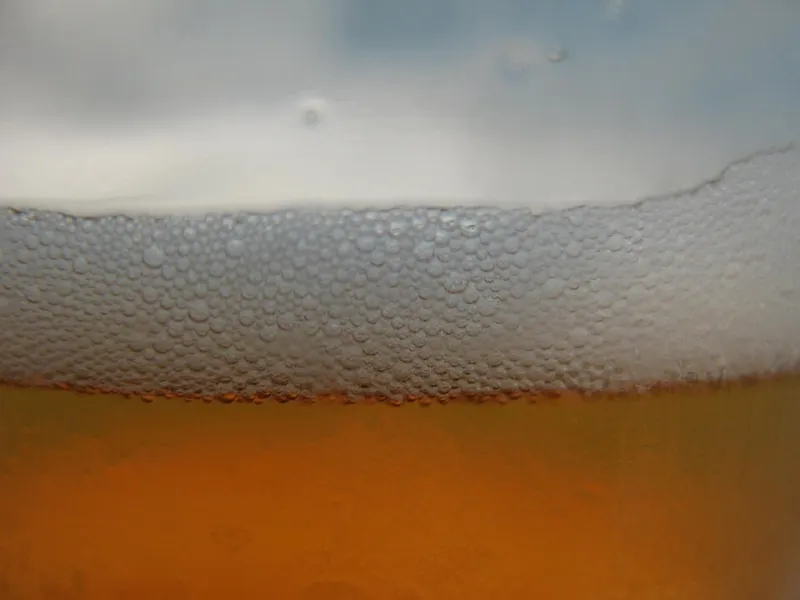
Photo: Public Domain Images, Public domain, via Wikimedia Commons
The first sip gets all the attention, but the head gets there first. Before you taste a beer, you see whether the foam rises, how long it lasts, whether it leaves lace on the glass, and how the bubbles behave as the pour settles. For a dark beer, that foamy cap is not decoration. It is a quick visual report on recipe design, freshness, and the way the beer was handled.
At Deep Dark Wood Brewing, we brew in small batches, which means we get to watch foam form and fade in real time. A stout that pours a dense, mocha-colored mousse is telling you something. So is a porter whose head collapses before the glass hits the table. Neither message is automatically good or bad, but both are worth learning to read.
Foam is a built structure, not a garnish
Beer foam is a network of proteins and peptides holding carbon dioxide bubbles in place. The proteins come mostly from malt, and they need to be foam-positive: soluble enough to make it into the beer, flexible enough to gather at bubble surfaces, and sturdy enough to keep the structure from draining away. Wheat and oats are famous for helping here. So is a healthy mash with good protein breakdown.
Hops matter too. Iso-alpha acids from hops help stabilize foam by strengthening the bubble walls. That is one reason a well-hopped beer can hold a head even when other factors are imperfect. Carbonation provides the gas, but it does not build the structure by itself. A highly carbonated beer with weak foam proteins will fizz and fade. A lower-carbonation beer with strong proteins can still pour a creamy, lasting head.
Dark malts complicate the picture. Roasted barley, black malt, and chocolate malt bring color and flavor, but heavy roast can work against foam. Too much roasted grain can reduce foam-positive proteins and add harsh notes that make the head look thin. Brewers who want a dark beer with a thick, persistent head often balance roast with oats, wheat, or a portion of less-roasted base malt. It is a recipe decision, not an accident.
The three usual suspects: fat, detergent, and time
If a beer that usually pours well suddenly has no head, look at the glass first. Detergent residue, rinse aid, and lipstick are foam killers. Fat from fingerprints, cheese, or fried food does the same thing. A clean glass is not a small detail; it is part of the serving equipment. At home, wash beer glasses with a mild unscented detergent, rinse them thoroughly with hot water, and let them air dry. Skip the dishwasher if you can.
Time is the second suspect. Foam-positive proteins can degrade as a beer ages, and hop acids change too. A fresh beer is not guaranteed to have great foam, and an older beer is not guaranteed to have bad foam, but freshness generally helps. Storage temperature matters as well. A beer that has been warm for months will not show the same foam structure as one kept cool and dark.
Carbonation level is the third. A beer poured from a keg with a badly balanced draft system can look flat or foamy for reasons that have nothing to do with the recipe. Bottle-conditioned beers can vary from bottle to bottle. If you are judging foam, pour a second bottle before you blame the brewer.
What a thick mousse can tell you
A dense, lasting head often points to a few things: enough foam-positive protein, a reasonable roast level, good carbonation, and a clean pour. In a stout, a tight, creamy head can suggest oats or wheat in the grist, or a brewer who deliberately built the recipe for texture. In a black lager, a rocky white-to-tan head can signal a crisp, well-attenuated beer with enough hop support to keep the foam standing.
Sensory experts also watch the foam as a flavor clue. Foam carries aroma compounds, and the bubbles release them as they collapse. A fresh, lively head can lift coffee, cocoa, and dried-fruit notes toward your nose. A flat, soapy head can make the same beer smell dull. That does not mean you should judge a beer by foam alone, but foam is part of the first impression, and first impressions are information.
When the head collapses
There are legitimate reasons for a dark beer to pour a modest head. High-alcohol beers can suppress foam. Very acidic or very highly roasted beers can struggle. Some traditional styles are meant to be low in carbonation. A barrel-aged stout may show a thin ring of foam and still be excellent. The mistake is assuming that every short head is a flaw or that every thick head is a guarantee.
A better read is change over time. Does the foam hold for a minute or two? Does it leave lace as you drink? Does the second pour from the same bottle behave the same way? If a beer starts with a promising head and loses it instantly, check the glass and the serving temperature. If it never forms a head at all, consider freshness and carbonation. If it gushes and then goes flat, the problem may be in the package.
Pour with a little intention
Start with a clean, dry glass. Pour down the side at first, then straighten the glass to build the head. Do not dunk the bottle neck into the foam. Serve dark beers a little warmer than lagers—around 50 to 55 F is a good starting point—because aroma and foam both behave differently when the beer is ice cold. And give the beer a moment. Foam is not just the opening act. It is the first chapter.